Around 9 percent of the Mumbai city’s land possesses half the slum population and this glaring inequality is dominant at a socio-spatial level. The failure of government incentivized market solutions to resolve the affordable housing crisis (Slum Rehabilitation Scheme, Pradhan Mantri Awas Yojna) is evident across Mumbai except in a handful of projects. This research plans to investigate lesser-known examples in the city of Mumbai, where communities have mobilized themselves to become housing providers, as a response to these market failures. Social innovation in itself, the process of Self Redevelopment involves communities coming together, registering themselves as a cooperative housing society, acquiring land, and being at the forefront. Through a case by case analysis of scattered attempts of self-redevelopment in Mumbai and comparative analysis, we argue the presence and role of multiple stakeholders like the State, private players, NGOs, activists, academicians, and certainly the users without whom this community-led execution shall be impossible. Our hypothesis is that slum development/ redevelopment is successful only in places where the users have been an integral part of the decision-making process.
Keywords: Affordable Housing, Social Innovation, Participatory Planning, Self-Redevelopment, Social Housing
SELF
RE
DEVELOPMENT
Independent Researcher
Project
goal
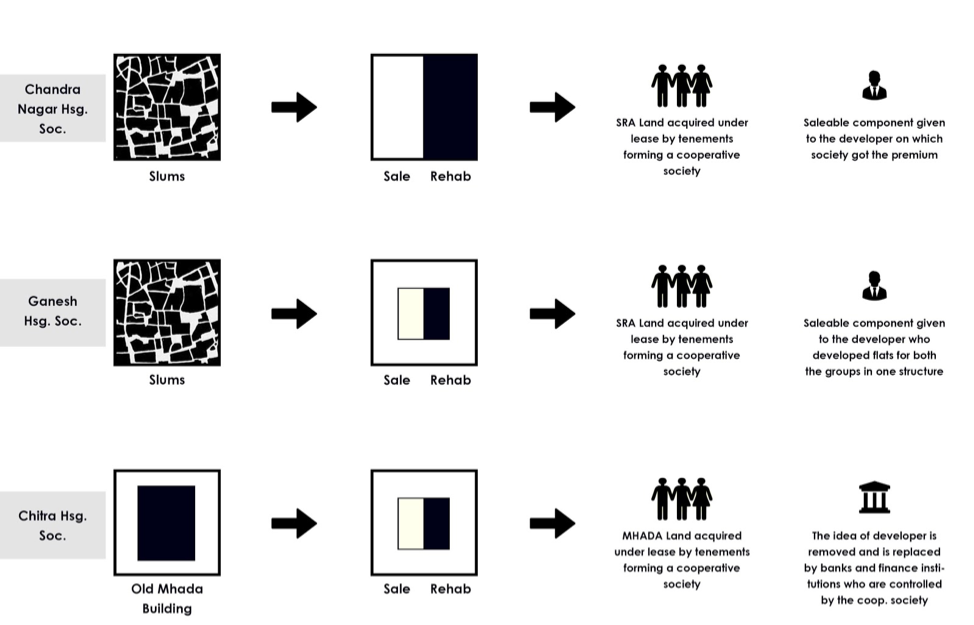
The research paper is an inquiry into existing and evolving housing redevelopment models in Mumbai. Through analyzing three concurrent real estate development cases, we are investigating the social housing in Mumbai by studying participatory planning, land ownership, and governance. The way we understand and conceptualize the term “social” housing is when different interest-groups and stakeholders in a system come towards a state of equilibrium but with a common intent of delivering effective housing services. The stakeholders can range from the State and NGOs to activists and beneficiaries. Each of them has a different intent and one of the major realizations after studying the failed models in the city is to have an alignment in the intent.


Project
IMpaCT
This research was published in one of the leading urban planning journals, Mumbai Reader 2020